Pilgrimage to Peebles: Cross Kirk and the Relics of Saint Nicholas
Updated: Jan 7
On this Saturday, December 6th, the Feast Day of Saint Nicholas, we decided to embark on a pilgrimage similar to one that various Kings and Queens of Scotland have taken in centuries past. To be more accurate, it wasn't a pilgrimage only reserved for royals. Furthermore, the historic pilgrimages would have been concentrated on two different dates annually- the Feast of the Exaltation of the Cross (14 September) and the Feast of the Finding of the Cross (a specific feast day said to coincide with the date of the discovery of the relics found on the site of our pilgrimage today – 1 May – which conveniently falls on the same day as the pagan celebration of Beltane). However, as the relics found here in 1261 were believed to have been the bone fragments and ashes of one of the most revered saints in all of Christendom – a fourth century bishop, Saint Nicholas of Myra, we felt that this was more than an appropriate day for our pilgrimage.

Now, if you know your saints, you might be asking yourself, are the Wee Walking Tours Golden Retriever Guides, Walter & Arthur, adventuring all the way to Bari, Italy, and visiting Basilica di San Nicola? The answer is no, not exactly, because we are heading just about twenty miles south of Edinburgh to one of the most beautiful towns in all of Scotland– Peebles.
At this point, you are probably wondering how on earth Peebles has anything to do with a 4th century bishop of Greek descent, born over two thousand miles away in Southern Türkiye. Well, to be honest, that is quite a mystery and a story (in fact it very well could be just a story), but if you are intrigued– get your cup of hot cocoa, gingerbread cookies, and a Santa hat, and join us on our adventure to the Scottish Borders!
To start our pilgrimage, we will briefly discuss the history of Saint Nicholas, and then how it all relates to Peebles. However, the very first thing we must distinguish is the fact that Saint Nicholas and Santa Claus are not the same. Similar, but not the same. Of course, Santa Claus is still very much alive and well living in Finland as he has for thousands of years, where he is preparing for his big day which is quickly approaching. Yes, you heard me correctly, Santa Claus is from Finland and not from the North Pole as Hollywood would have you believe. He lives in the Finnish Lapland, in a place called, Korvatunturi. Find the truth at https://santaclausfinland.fi/en/
However, this adventure is not about Santa, but rather about a saint who also provided people with gifts and miracles. In fact, Saint Nick is still celebrated in many places around Europe and beyond, with celebrations taking place on the Feast Day of Saint Nicholas, or on the eve of the feast day– 5 December (some places celebrate the feast day on 19 December). And, yes, some of the traditions, like placing gifts into shoes or stockings for all those who have been good, and lumps of coal for those who have been naughty, are very much like the customs that have been hijacked into modern day Christmas celebrations.

That is, in a way, what makes the story of Saint Nicholas (or more specifically the relics of his remains) intriguing, because they have also been ransacked and hijacked on several occasions. But, before we discuss the relics, let’s first discuss the person.
Historically speaking, very little is known about Saint Nicholas because most of the stories about him were written hundreds of years after his life. However, he is believed to have been born on 15 March 270, near Patara, an ancient maritime city in Antalya Province of Southern Türkiye, into a wealthy Christian family. Later in his youth, his family's wealth enabled him to go on a pilgrimage of his own to Egypt, Syria, and Palestine. It is said that it was after this pilgrimage that he became the Bishop of Myra (Myra is another ancient town located near Patara).
His family’s wealth also possibly helped him to perform one of his earliest acts of kindness, even before he became a bishop. According to the legend, there were three young girls in his village who were being forced into prostitution unless their father could come up with dowries for them and marry them to potential suitors. Unfortunately, the father did not have the means to come up with the dowry for each of his daughters. So, according to the legend, Nicholas secretly dropped three bags of gold coins through a window (some speculate that he dropped the bags of coins through a chimney) so that the man could save his three daughters from a horrible fate.

Some of his other actions include calming the seas, freeing the wrongly convicted, and resurrecting three murdered children, just to name a few. However, he is most famously known for secretly giving gifts to those in need. Therefore, it is not that surprising that he became venerated as a saint after his passing on 6 December 343. His list of patronage is perhaps longer than anyone’s Christmas list, because he is the patron saint of sailors, merchants, archers, children, toymakers, repentant thieves, unmarried people, students, etc. He is also the patron saint of numerous cities and countries. Cities like Aberdeen, Amsterdam, Liverpool, etc. and countries like Albania, Greece, and many more!
The remains of this highly venerated saint were originally believed to have been entombed in Saint Nicholas Church in Myra. However, it is now commonly thought that Nicholas the Bishop of Myra was initially buried in a rock-cut tomb in a church on the small Turkish island of Gemile (now known as Gemiler Island). The island was known in the past as the “Saint Nicholas Island”.

Due to attacks by Arabs in the 7th century, his sarcophagus was then removed and taken to the church named after him in Myra. There, all of his relics were laid in ‘eternal’ rest in his tomb. That tomb became a very popular place for pilgrims and other visitors because of the alleged miracles said to have been associated with his relics. But that rest would not be eternal after all, because when you have relics connected to miracles, there will be others who want their share of them- often by any means necessary.

Which brings us now to Bari. By the Spring of 1087, Myra had come under the jurisdiction of the Seljuk Turks, and the “Church” had its schism. Therefore, many in the West worried about being able to access the relics. That is when Italian sailors from Bari decided to take matters into their own hands by ransacking the church in Myra and taking with them most of the larger relics/bones. Once in Bari, Pope Urban II, established the Basilica di San Nicola and placed the relics beneath the altar. That day is still celebrated every year on May 9th in parts of the Western Church as the ‘Day of Saint Nicholas’ Translation’. The argument is that they saved these important relics from the ‘East’. Whereas in Türkiye, among the Turks as well as Christians who are part of the Eastern Orthodoxy, this act is referred to as “Holy Robbery” or, to put it simply- blatant theft.


While it is fair to say that Saint Nicholas’ popularity grew in the West after this 'Translation', it also might have put some of those relics in further danger. This is because Bari served as a pitstop along the Crusades, and it would have been very common for some of those relics to be dispersed further around Europe by the Crusaders.

We know that Scotland has a history not only with Crusaders, but also of various monastic orders and abbeys who would have been very keen to have important relics of their own. That doesn't even include countless monarchs, nobles, knights, and others who would have liked to enhance their status by possessing an important relic. So, that now brings us to the relics of Saint Nicholas found in Peebles. Were they brought in by some returning Crusader or perhaps one of the Knights Templar?

Afterall, the long-held belief is that the treasure of the Knights Templar is buried somewhere in the nearby town of Temple.

I mentioned earlier that the 'rescuers/thieves' from Bari took with them most of the larger relics/bones. So that means that they left a lot behind in Myra. However, not for very long, because by 1100, the Venetians stole the rest and brought them to Venice. A lot of them still reside there, but the Venetians were known for trading, and they traded numerous relics across Europe. That is why you can make a pilgrimage to Thomastown in Ireland, Watten in Belgium, Nancy in France, as well as other locations as far as parts of Russia and the United States. So then why not in Scotland?
Which finally brings us to Peebles. Welcome to the ruins of Cross Kirk!

The Church of the Holy Rood, or The Church of the Holy Cross, was founded in 1261 by King Alexander III on the site of the discovery of a cross and an urn containing the relics belonging to Saint Nicholas.

The shrine wall honouring the saint was placed along the south wall. Which ends up dictating a rather unique fact about Cross Kirk. Once it further grew into a Trinitarian monastery in 1474, the associated cloister was built on the north side, rather than the usual south side of the church, to better accommodate the countless pilgrims flocking to the site. The monastery continued to grow both in importance and in size, including the large bell tower added to the west side of the church in the 15th century. This growth also extended to the town of Peebles as well, because the large masses of pilgrims required alms houses, hostels and so on.
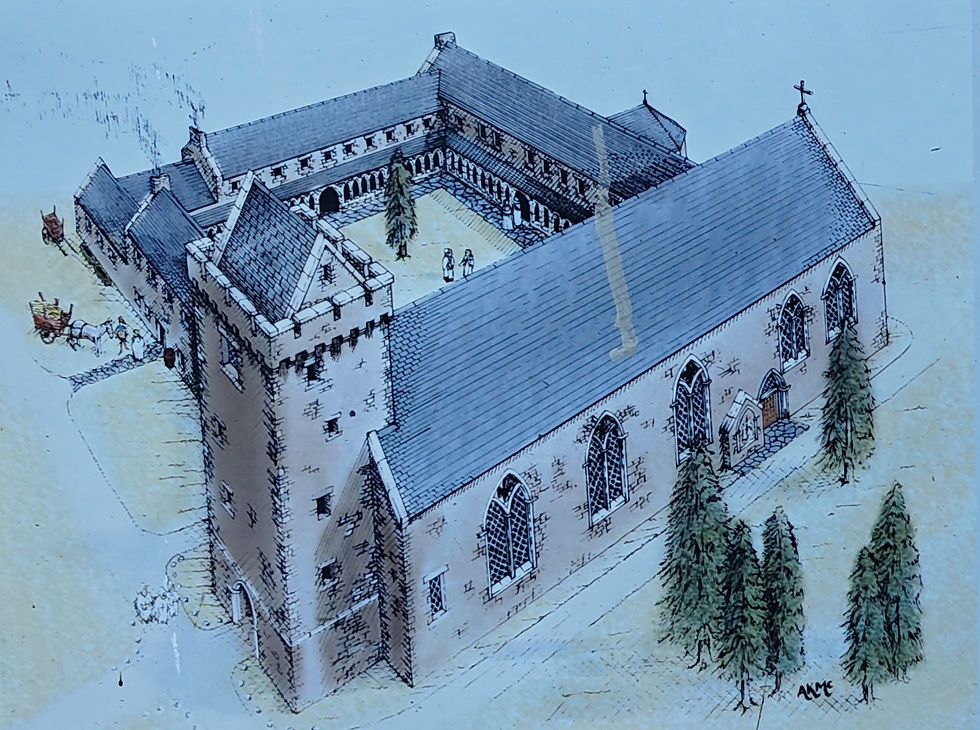
Unfortunately, the good times did not last. The church flourished through the Wars of Independence, plagues, and even climate change. In fact, it even survived the time of the “Rough Wooing” (when the English burned down half of Scotland in the name of their King, Henry VIII, who thought that he would ‘woo’ the Scots to allow their Queen, Mary Queen of Scots, to marry his son). Technically, the church was burned by the English in 1549, but it was rebuilt and fixed in no time. However, an even bigger threat was looming just around the corner– The Reformation!

I guess you could say that most of the structure survived, but the monastery, its customs, and relics did not. For the reformers, veneration of relics or any idolatry was sinful. Now, just to be clear, we are not here to judge anyone’s faith or beliefs, but we do, however, believe in freedom of religion. To us, that means that these reformers should not have judged the Catholics either. It is absolutely heart-breaking how much rich history and art, including relics, statues, paintings, books, etc. have been lost to history in the wake of the destruction that many of the reformers left behind. Countless churches, monasteries, friaries, abbeys, chapels and cathedrals were burnt to the ground. Just look around Scotland– it is full of ruins; ruins of places that would rival some of the most beautiful structures ever built anywhere.

As for The Church of The Holy Cross, it got a small reprieve, because the other church in town, Saint Andrew’s Church founded in 1195, had also been burned to the ground by the English. Therefore, a decision was made to convert the old monastery and the Church of the Holy Cross into a new Parish Church– Cross Kirk. The church was drastically altered, and parts of it, like the cloisters, were torn down in order to use the stones on other building projects around the town. However, the church survived- especially in the hearts of the many locals and others from far and wide. Despite all the bans against pilgrimages, many of the faithful were willing to risk it all in search of miracles.
Cross Kirk’s final blow came when a new parish church was built in 1784. At that time, the roof was taken off from the church, and the building was left in ruin. Since then, there have been several times when the ruins themselves have faced further threat of demolition. However, thanks to the tireless efforts of many locals, they have been preserved.
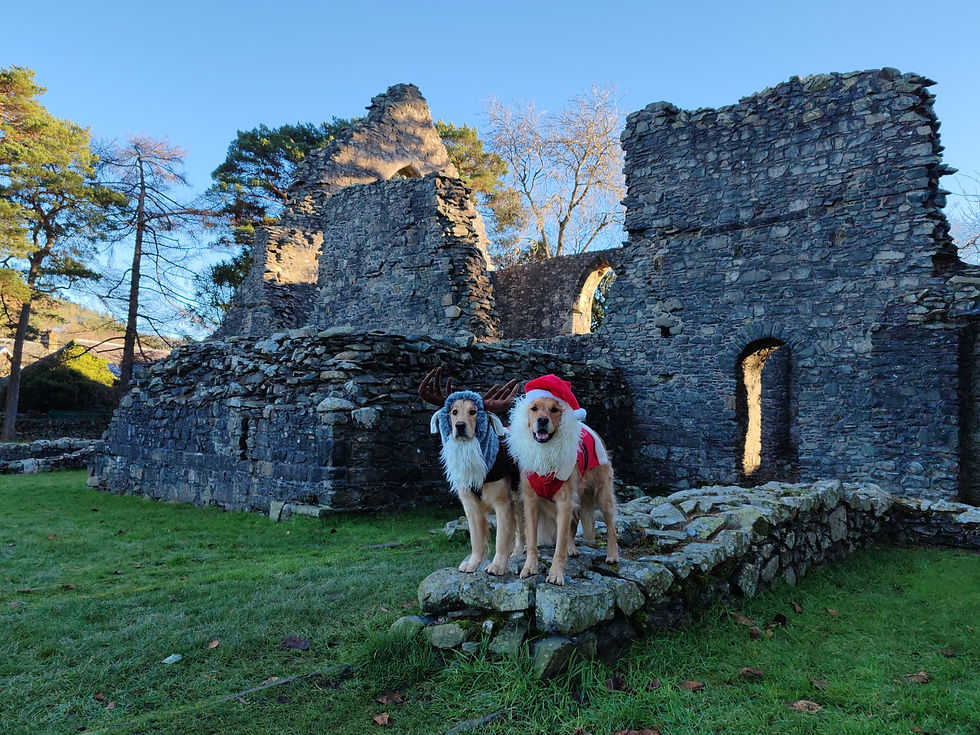
Nowadays, Cross Kirk is in the care of Historic Environment Scotland. Hopefully, these beautiful ruins will continue to stand as a reminder of the area’s rich history and past to all future generations.

So, the next time you happen to find yourself in Peebles, we highly recommend you take a wee walk to Cross Kirk. It sits in a beautiful and peaceful wooded lot, surrounded by magnificent pine trees, offering you an oasis of calm near the centre of the town. And, hey you never know, you might even witness a miracle or two. Because, just as we know that Santa comes from Finland, we wholeheartedly believe that miracles also exist. Especially in Peebles!
Safe travels and Happy Feast Day of Saint Nicholas!
Until next time- Explore & Discover!


