Mystery, Intrigue, and Secret Rituals Revealed in Edinburgh: The Grand Lodge of Antient Free and Accepted Masons of Scotland
This week we visit an organisation said to be shrouded in mystery. It is the home to a society known for secret rituals and often linked to bizarre conspiracy theories. So, join us we reveal where the Freemasons call home in Edinburgh!

History of Scottish Stonemasons
Freemasonry’s roots go back centuries in Scotland under the auspices of the stonemasons. Let’s set the stage - it’s the late 1500s and Scotland has experienced immense political instability with the transformation of life under the Scottish Reformation. The Church had once been an important patron for stonemasons, but many of those churches and abbeys were being torn down or destroyed (you can read more about this in our previous articles on different abbeys throughout Scotland - just type in “abbey” into our blog homepage search bar to explore more). I imagine it must have seemed quite dire for the craft of stonemasonry by this point.
However, King James VI (son of Mary, Queen of Scots) tasks his Master of Work and Warden of stone masons, William Schaw, to help him ‘rebuild’ the castles and royal residences in Scotland. Many of them had languished for decades after the capture and imprisonment of his mother by Queen Elizabeth I of England. Now he wants to restore some of them and provide much needed updates. To do this, he has Schaw create a network of lodges to help organise the masons. In 1598 and 1599, Schaw puts forth a set of statutes and ordinances that must be followed by the masons throughout Scotland.
One notable factor to keep in mind is that the church no longer had the Catholic rituals that were a large of part of Scots’ lives for centuries. However, human beings crave ritual and find comfort in the sense of order that it brings; it was a void just waiting to be filled. Many of the former religious rituals became masonic ones with a mix of practical and mysterious aspects to them.
The stonemasons were also looking for exclusivity and to set themselves apart from others because they believed that their trade was above all others. They wanted to protect the secrets of their craft that had been passed along the generations. Members took an oath not to reveal what happened during the initiation ceremony. They also needed a way for members to identify each other, and this was done through secret handshakes that only initiates would know. Thus, a set of secret rituals were developed that created an air of intrigue and mystery which continues to this day.
The stonemasons applied mathematical fields- specifically geometry- to their craft and thought of themselves as architects. They also used this knowledge to try to make sense of the world around them. Therefore, they viewed their lives through the same perspective that they took when building - a building won’t stay standing if it isn’t built properly. This same concept was applied to their lives, and they believed that they needed to stay morally upright and true. They thought of God as the Divine Architect or Architect of the Universe.
From Stonemasons to Freemasons
While the original goal was for exclusivity and membership reserved only for stonemasons, non-stonemasons gradually joined lodges throughout Scotland. They most likely had started to accept non-stonemasons for a variety of reasons including the money and prestige that admitting gentry would provide. Having those of the upper classes among their ranks probably made the stonemasons feel even more important and of a special status (especially as these two groups of people wouldn’t normally interact outside of the lodge due to separation of the classes). At the same time, the gentry wanted to join the stonemasons because of the allure of a secret society - wanting to know what was happening behind closed doors. Ultimately, it also gave them a sense of belonging.
One of the key figures related to the admittance of non-stonemasons was Sir Robert Moray who was initiated in 1641. This historic moment is one many recognise as a key point in the transition from when the stonemasons became the Freemasons. Moray was Scottish and had an impressive political life as a soldier, diplomat, and spy. Later in life, he focused on his scientific research of tidal phenomena. In fact, he was one of the founding members of the Royal Society (often described as the birthplace of modern science) and served as its first president.
People who joined the freemasons in the early days were a lot like Moray in that they were often involved with practical skills such as astronomy, surveying, and navigation. Freemasonry is grounded in the concepts of ‘Brotherly Love, Relief, and Truth’. Men are not meant to compete but to work together in harmony and brotherhood. Let’s head into the Grand Lodge of Scotland to see what a Masonic lodge looks like in person.
The Grand Lodge of Scotland
For an organisation that is often accused of being wrapped in secrecy, the chance to visit the Grand Lodge of Scotland in Edinburgh was one that we couldn’t pass on. To be more precise, it is known as ‘The Grand Lodge of Antient Free and Accepted Masons of Scotland’. It was founded in 1736 and is one of the oldest Masonic Grand Lodges in the world. Our visit was part of Doors Open Days in September 2025.
The Grand Lodge of Scotland is located on George Street with a rather unassuming facade adorned only with a prominent statue of St. Andrew, Patron Saint of Scotland, above the entryway.
Touring the Lodge, the importance of ritual and belonging was evident at every turn. For example, Masonic symbols can be found throughout the building. While interpretations can vary, we will discuss just a few of the most well-known symbols. The square and compasses (often with the letter ‘G' in the centre) is one of the most recognisable symbols of Freemasonry. The square and compasses are said to represent balance and discipline. The letter ‘G’ refers to ‘geometry’ or ‘God’. The all-seeing eye represents awareness and accountability.
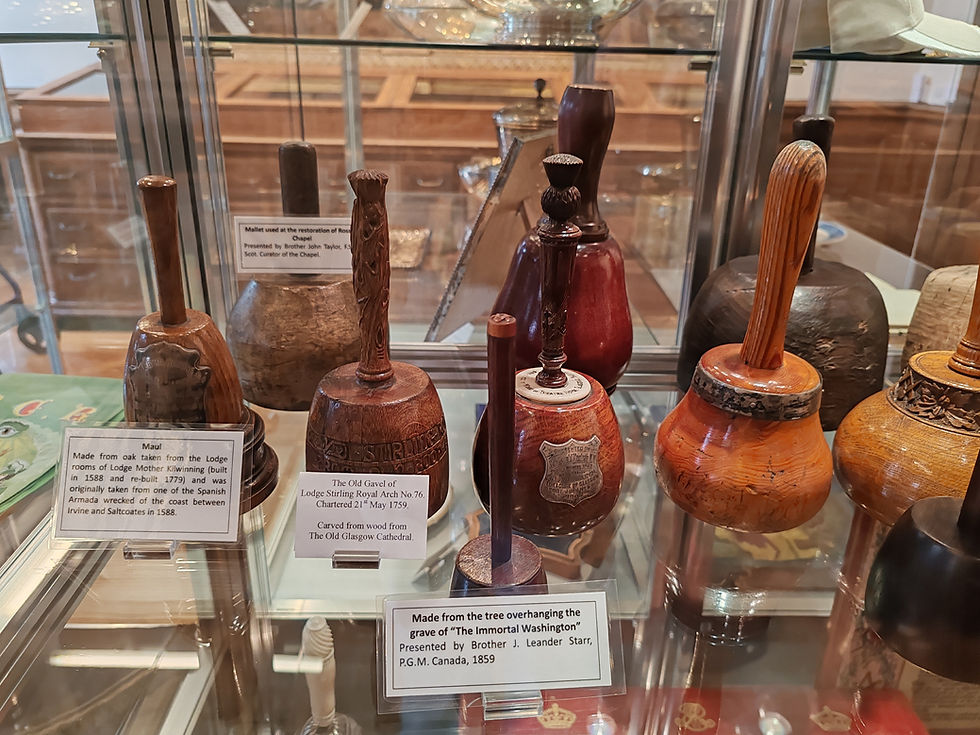
One distinct Scottish Masonic tradition is the use of the ‘maul’. According to the Grand Lodge of Scotland, “in most Lodges in Scotland the Master and Wardens use a Maul. This was one of the main working tools of a stonemason. We know that stonemasons simply took their working tools from their daytime labour building site to Lodge meetings in the evening. In short, the working tools were used for practical as well as speculative purposes…Today such items are decorative rather than practical”. In Scottish Lodges the Maul is used to keep order (in the same way that gavels are used in courts of law in the U.S.).
Some famous Freemasons are on display in the Lodge. The first Grand Master of Scottish Freemasonry was William St. Clair, Baron of Roslin (you can read more about Roslin in our article on Rosslyn Chapel). There is a portrait of St. Clair in the Grand Committee room (see portrait to the left below of the man standing) as well as the Letters of Jurisdiction given to St. Clair (dating to ~1628).
The celebrated Scottish poet, Robert Burns, was also a Freemason. His masonic apron took pride of place on display (framed above the fireplace) when we visited.
The Duke of York (later King George VI) was installed as the Grand Master Mason of the Grand Lodge of Scotland on St Andrew’s Day - 30th of November 1936. The Lodge has some of his Masonic memorabilia on display.
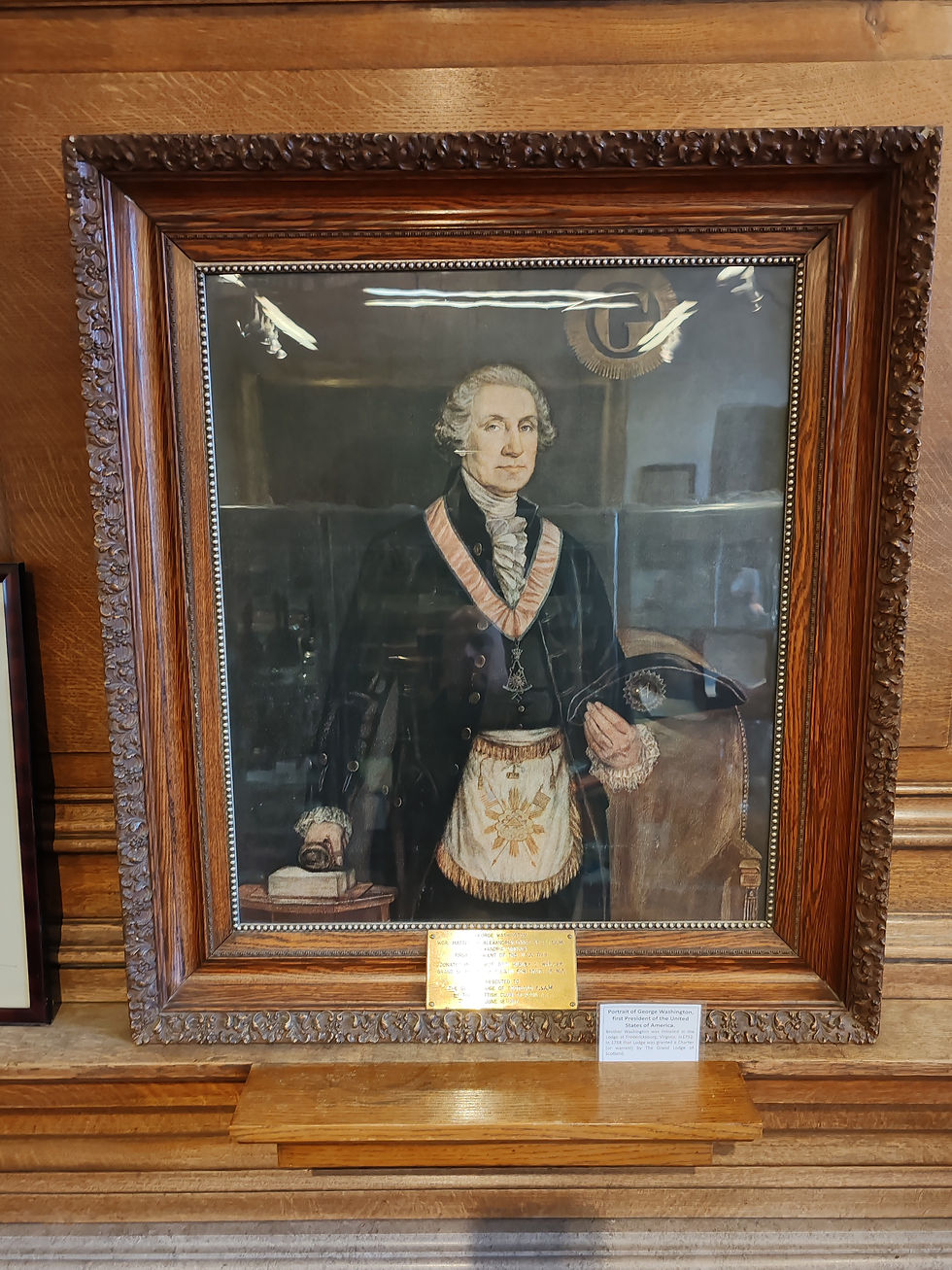
Of course, many of our American readers know of the importance of Freemasonry during the American Revolution and subsequent ‘birth’ of the United States as a nation. George Washington is probably one of the most famous Freemasons and there is a portrait of him at the Lodge. He applied many Masonic principles to the new government.
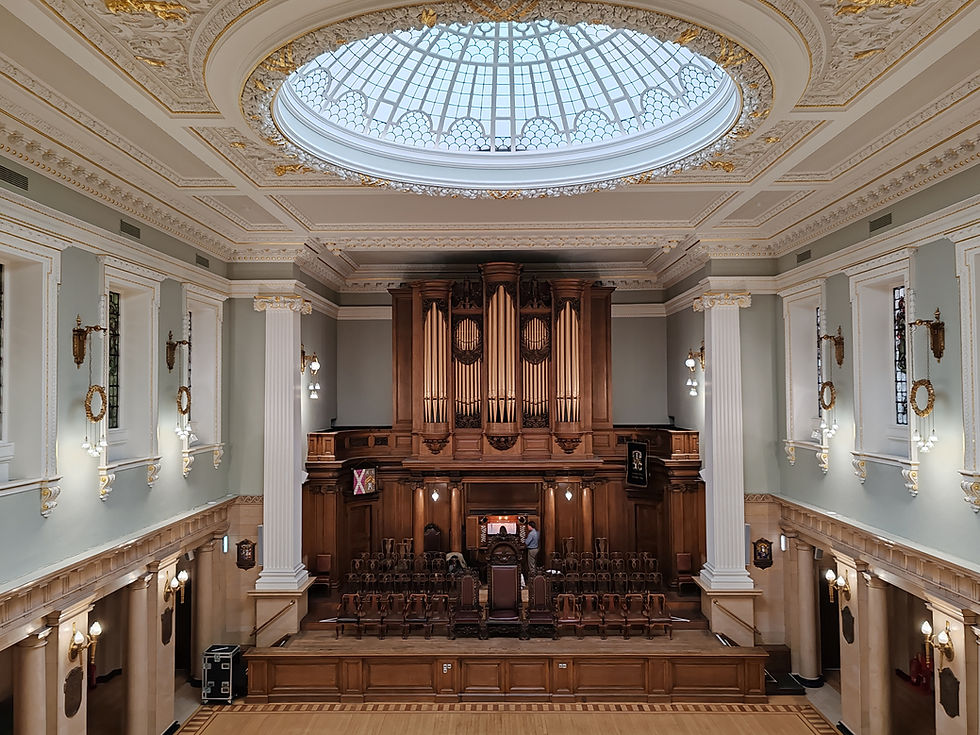
Here are some more photos from our visit. The building architecture is magnificent, and there are many fascinating artefacts in display in their Museum.
Well, that is going do it for our visit to the Grand Lodge of Scotland in Edinburgh. We hope that we have been able to shed some light on Freemasonry in Scotland and show that, in reality, it is not as secret of an organisation as some may have claimed it to be. All the Brothers at the Lodge were very helpful and we observed them gladly answering all sorts of questions from visitors. You can visit their website for more information - including how you can book your own tour (they are free) or how you can hire Freemasons’ Hall for an event.
Until next time - Explore & Discover!


